Chapter 4 Insights
Road safety · 606 insights
Children's shorter stature limits their visual field, focusing their vision closer and missing distant information.
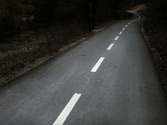
Night Vision Assistant uses infrared to detect pedestrians or animals beyond headlight range, highlighting them on screen.

The economic cost of traffic accidents affects all of society, paid directly or indirectly by everyone.
Licence seniority is counted from the first licence obtained, so the 0.3 g/l limit applies for two years total.
Children under 1.35 m must travel in the rear seat using an approved restraint device suited to their size.
Proper ventilation and a comfortable cabin temperature help delay the onset of fatigue while driving.
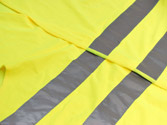
Drivers must wear a reflective vest on interurban roads whenever occupying the carriageway or hard shoulder, day or night.
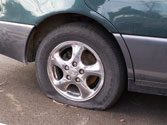
After a tyre blowout, reduce speed gradually; sharp braking destabilises the vehicle and risks loss of control.
Airbags and headrests only function effectively when combined with a properly fastened seatbelt.
Alcohol reduces the visual field, causing the tunnel effect where only the centre of the road is seen clearly.
Novice drivers tire more easily because lack of experience makes driving more mentally and physically demanding.
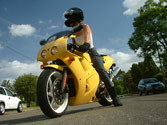
Motorcycles, with or without sidecar, must have one or two low-beam headlights at the front.
The faster you drive, the further ahead you must look to anticipate hazards and react in time.
Vehicle lighting is an active safety element designed to let you see and be seen.
Alcohol impairs attention, making distractions more likely, especially in complex traffic situations.
Driving a truck up to 3,500 kg GVW requires a breath alcohol level no higher than 0.25 mg/l.
Poor psychophysical condition increases reaction time, reducing the driver's ability to respond to hazards.
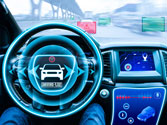
After starting a diesel engine, wait a few seconds before setting off so oil reaches lubrication points.
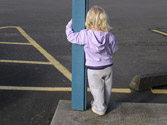
Always take extra precautions near children and elderly people, who are unpredictable and vulnerable pedestrians.
Alcohol impairs attention, increasing the likelihood of distractions, especially in complex traffic situations.
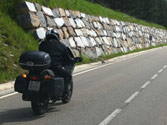
A reflective vest is recommended but not mandatory for motorcyclists, as it improves their visibility.
ABS prevents wheel lock-up during braking, allowing the driver to maintain steering control.
Drowsiness blurs vision, hinders focus, and causes eye fatigue, impairing perception of the surroundings.
Good lighting lets the driver detect hazards in time to react under poor visibility conditions.
Fatigue reduces sensory abilities, including hearing, alongside attention and movement precision.
The seatbelt is not required when reversing or performing parking manoeuvres.
If you have a chronic illness, know your condition and avoid situations that could trigger a crisis at the wheel.
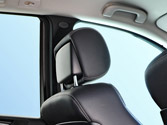
Position the headrest's upper edge between the top of the head and eye level, with minimal gap.
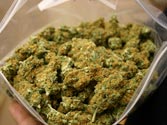
Cannabis increases drowsiness and reaction time while reducing concentration and altering perception.
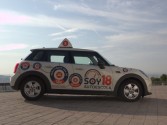
In a driving school car, the legal driver is the instructor, who controls the dual pedals.
Before driving while medicated, read the leaflet and consult a doctor or pharmacist if in doubt.
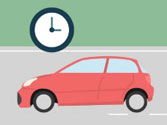
Reaction time is the interval between perceiving a hazard and beginning to respond to it.
Drowsiness slows decision-making and increases mistakes, particularly when quick responses are needed.
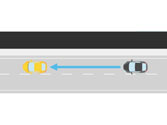
In urban areas, keep enough distance to stop without colliding if the vehicle ahead brakes suddenly.
A child under 1.35 m may exceptionally travel in the front seat with an approved restraint if there are no rear seats.
Improper use of medications can increase the risk of suffering a traffic accident.
On long journeys, take rest breaks of 20–30 minutes every two hours or 200 kilometres.
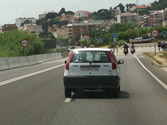
If the driver doesn't respond to a lane departure warning, LKS corrects the steering or braking to recentre the vehicle.
Alcohol absorbs into the bloodstream more slowly when consumed with food in the stomach.
Novice drivers (first 2 years) are limited to 0.15 mg/l in exhaled air or 0.30 g/l in blood.
During the first two years of holding a licence, the breath alcohol limit remains 0.15 mg/l.
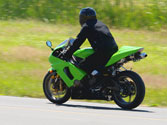
Motorcyclist clothing is essential passive safety, protecting against injuries and weather elements.
On long journeys, rest approximately every two hours or every 200 kilometres to prevent fatigue.
The PAS rule for accidents stands for Protect, Alert, and Assist — performed in that exact order.
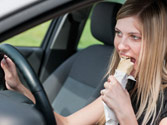
Distractions at the wheel are responsible for around 40% of traffic accidents.
Frequent drinking and driving greatly increases the long-term probability of suffering or causing an accident.
Using a mobile phone while driving most commonly causes the vehicle to drift from its intended trajectory.
Only one reflective vest must be carried in the vehicle; an extra one for the passenger is optional.
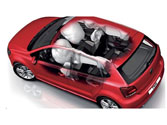
The airbag only protects effectively when used together with a fastened seatbelt.
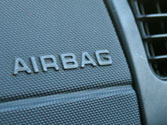
Without the seatbelt, the airbag loses effectiveness and can itself cause serious injuries.