Key Insights
2818 insights
Compulsory insurance covers damage to others when the driver is civilly liable.
If you lose your driving licence, request a duplicate from the Provincial Traffic Authority.
Acoustic warnings are permitted on narrow, winding roads to prevent accidents.
Motorcycles up to 100 km/h need only a left mirror; the right one is optional.
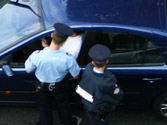
Always carry and present the driving licence, registration document, and ITV card.
During the first year, novice drivers must display the L plate.
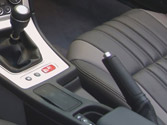
The handbrake keeps the vehicle immobilised when parked.
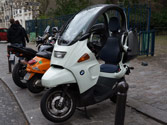
A motorcycle with self-protection structure needs only one left mirror if it doesn't exceed 100 km/h.
Compulsory insurance does not cover personal injury to the driver of the insured vehicle.
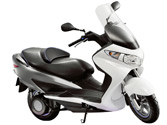
Motorcycles need one left mirror up to 100 km/h, and one on each side above that speed.
Drivers are responsible for their infractions; for minors, parents or guardians answer.
The ITV card certifies the vehicle's technical fitness to circulate on public roads.
A class B licence does not authorise riding motorcycles over 125 cc.
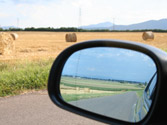
In passenger cars, the left exterior rear-view mirror is always mandatory.
A passenger car may carry up to three rear-view mirrors: two exterior and one interior.
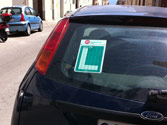
During the first year, novice drivers may not drive without the L plate displayed.
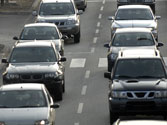
On heavy-traffic roads, the horn may be used only when strictly necessary.
Motorcycles over 4 years old must undergo the ITV every 2 years.
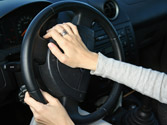
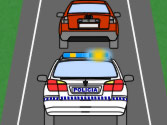
Acoustic signals must be of a non-strident sound; sirens are reserved for priority vehicles.
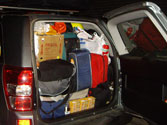
If the interior mirror lacks visibility, both exterior mirrors become mandatory.
When luggage blocks the rear window, both exterior side mirrors are mandatory.
On motorcycles, the front brake lever is operated with the right hand.
Two-wheeled mopeds require a left mirror; the right one is optional.
A B licence allows riding 125 cc motorcycles in Spain after 3 years' seniority.
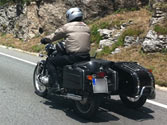
B licence holders with 3+ years may ride sidecar motorcycles within national territory only.
B licence holders with 3+ years may ride a 125 cc motorcycle, but only nationally.
After passing its first ITV, a car must be re-inspected every 2 years until age 10.
Motorcycles authorised by an A1 licence must display a registration plate.
If a motorcycle has only one mirror, it must be on the left side.
On motorcycles, the throttle is operated with the right hand.
The registered owner is responsible for taking the vehicle for its ITV.
A new private passenger car must undergo its first ITV 4 years after first registration.
Unauthorised races on public roads are prohibited and cause loss of licence points.
Adaptive lights improve visibility on curves and intersections by adjusting the beam.
Drivers are liable for traffic infractions; minors' parents or guardians answer for them.
After its first ITV, a motorcycle must undergo subsequent inspections every 2 years.
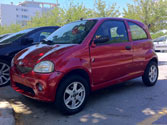
Quadricycles with bodywork need an interior mirror and a left exterior mirror.
Two-wheeled mopeds are only required to carry the left exterior rear-view mirror.
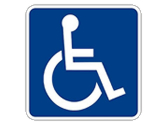
Vehicles displaying the disabled (V-15) badge may use HOV lanes even with only the driver.
A passenger car must carry the registration certificate, ITV card, and driving licence.
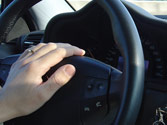
Within built-up areas, the horn is allowed only to prevent a possible accident.
Significant technical changes require an immediate extraordinary ITV inspection.
In passenger cars, the left exterior mirror is always mandatory.
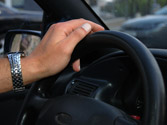
Hold the steering wheel with arms slightly bent, never fully extended.
A driving licence is only valid as long as the holder retains some points.
Correct seating means legs slightly bent, body straight, back against the seat.
A passenger car may carry only the left exterior and interior mirrors if visibility is good.
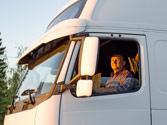
A class B licence does not generally authorise driving vehicles over 3,500 kg MAM.
A change of address must be reported to the Traffic Authority within 15 days.
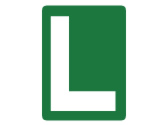
In passenger cars, novice drivers display the L plate visibly on the rear left side.