Key Insights
2818 insights
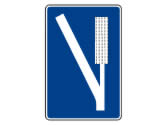
This sign marks an emergency escape lane for vehicles with brake failure.
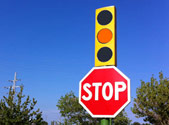
Vertical signs always take precedence over road markings on the pavement.
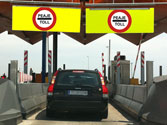
A circular red-bordered stop sign requires a mandatory stop before proceeding.
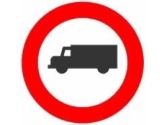
This sign bans all goods-transport trucks and vans regardless of their weight.
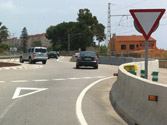
The inverted triangle 'give way' sign requires yielding only when other vehicles are approaching.
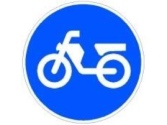
A mandatory moped lane sign reserves that road exclusively for moped riders.
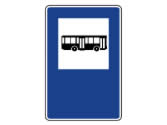
This sign marks a reserved bus stop location, not a bus-only lane.
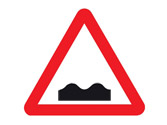
This sign warns of bumps, dips, or an uneven road surface ahead.
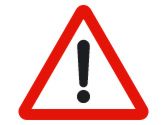
A triangular sign with an exclamation mark warns of an unspecified hazard ahead.
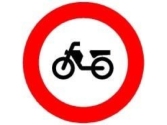
This sign prohibits entry to mopeds, light quadricycles, and reduced-mobility vehicles.
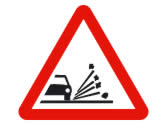
This sign warns of a stretch where loose gravel may be projected by passing vehicles.
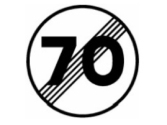
A round white sign with a diagonal line cancels a previously imposed prohibition.
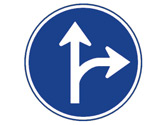
Mandatory direction-and-lane arrows require following one of the indicated paths and forbid changing direction.
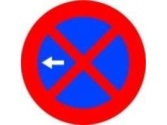
This sign prohibits both stopping and parking until the next intersection in the arrow's direction.
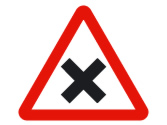
This sign warns of an intersection where vehicles approaching from the right have priority.
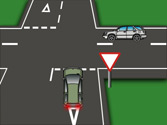
The inverted triangle requires giving way to all vehicles on the approached road.
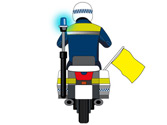
A yellow flag from an officer warns of imminent danger requiring extreme caution.
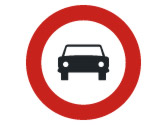
This sign bans all motor vehicles except two-wheeled motorcycles without a sidecar.
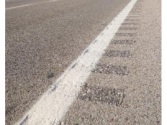
Edge rumble strips alert drivers through vibration when they drift out of their lane.
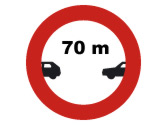
This sign requires keeping at least the indicated distance from the vehicle ahead, except when overtaking.
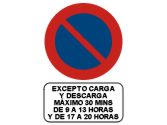
A no-parking sign with hours allows only loading and unloading during those times.
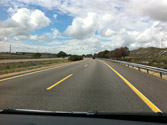
Yellow road markings or yellow-background signs indicate a roadworks zone.
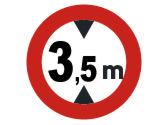
A height-limit sign bans vehicles exceeding that height, including their load.
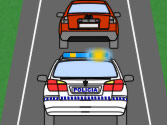
When police signal you to stop, pull over to the right in a safe spot and follow instructions.
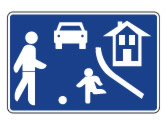
In a residential 'play and stay' zone, pedestrians always have priority over vehicles.
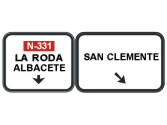
White exit signs lead to conventional roads; blue ones lead to motorways or dual carriageways.
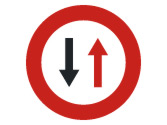
This narrow-passage sign requires you to wait and yield to oncoming traffic.
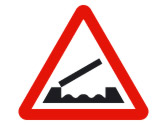
This sign warns of a movable bridge that may temporarily interrupt traffic.
At unregulated marked pedestrian crossings, pedestrians always have right of way.
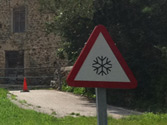
This sign warns specifically of a road surface made slippery by ice or snow.
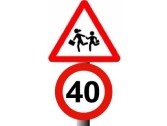
A speed-limit sign paired with a hazard warning applies only while that hazard persists.
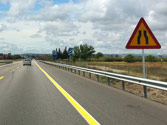
Roadwork signs share the same meaning, shape, and symbols as their standard counterparts.
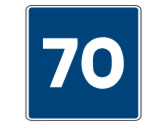
This sign shows the maximum recommended speed even under favourable conditions.
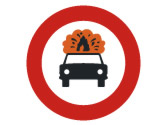
This sign bans all vehicles carrying explosive or highly flammable goods.
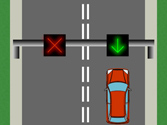
A green arrow traffic light does not exempt you from obeying stop or give way signs.

A round electronic-toll lane sign requires exclusive payment by electronic toll system.
Traffic officers may give both optical and acoustic signals, and their orders override all others.
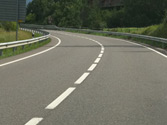
A broken line with closely spaced dashes warns of an approaching continuous line or hazardous section.
Most accidents happen on straight roads because drivers relax and lose attention.
Safe braking distance depends on tyre, brake, road, load, speed and weather conditions.
The 360° bird's-eye view is built from cameras placed around the vehicle's perimeter.
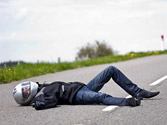
Helmets protect the head and face from abrasion when sliding along the road.
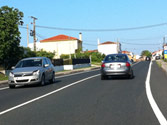
Always keep enough distance to stop without colliding with the vehicle ahead.
Excessive heat inside the vehicle increases the driver's reaction time.
Mobile phone distraction most commonly causes the vehicle to run off the road.
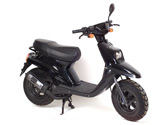
Helmets are mandatory for moped riders on all roads, urban and interurban.
In heavy rain on a motorcycle, slow down and stop if necessary.
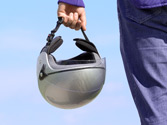
All motorcycle drivers and passengers must wear an approved helmet on every road.
ABS prevents wheel lock-up during braking, keeping the vehicle controllable.
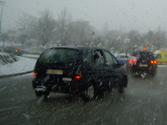
Always increase the safety distance in adverse weather conditions.