Vehicle Lighting: See and Be Seen
The lighting system is a crucial active safety element. Its purpose is twofold: to allow you to see the road and traffic conditions, and to ensure that other users see you with sufficient advance notice. The correct use of lighting is fundamental to preventing accidents, especially in low-visibility conditions.
General Use of Lighting
The general rule requires the use of lighting from sunset to sunrise. In addition, it is mandatory to turn on the lights at any time of day in tunnels, underpasses and special lanes (reversible, additional or enabled for travel in the opposite direction). They must also be used in weather or environmental conditions that significantly reduce visibility, such as fog, heavy rain or dust clouds.
Types of Lights and Their Correct Use
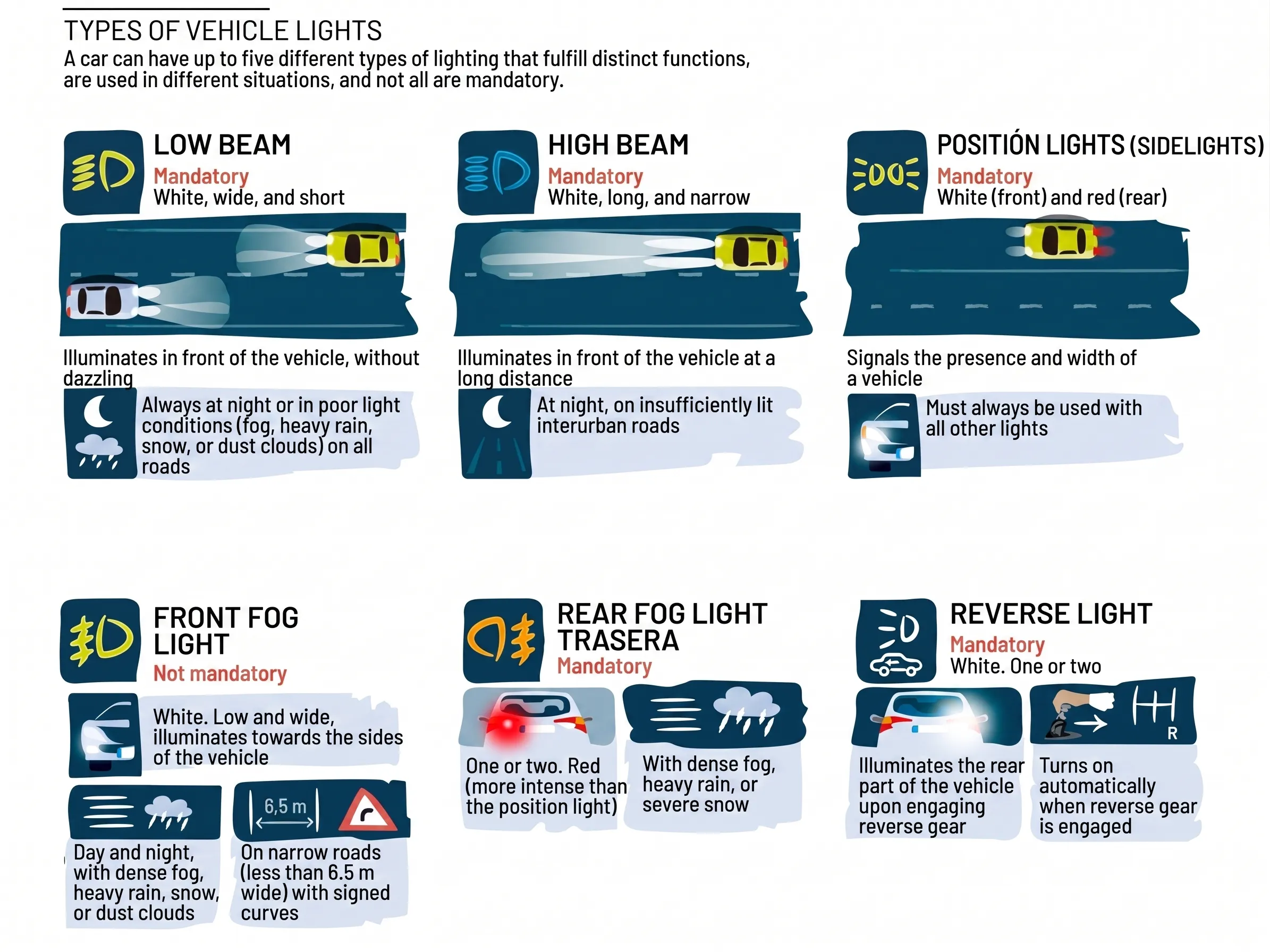
Each type of light has a specific function and a regulated time of use to maximize safety and avoid dazzling other drivers.
Position Light: Indicates the presence and width of the vehicle. You must never drive using only these lights. They must always accompany low-beam, high-beam or fog lights. They are mandatory for immobilizing the vehicle at night on the shoulder or roadway of an interurban road.
Low-Beam or Dipped Light: This is the main light for nighttime driving on all types of roads and during the day in the situations already mentioned. Motorcycles are required to keep it on permanently.
High-Beam or Main-Beam Light: Provides intense lighting over a long distance. Its use is restricted to insufficiently lit interurban roads, which are those where a license plate cannot be read at 10 meters or a dark vehicle cannot be distinguished at 50 meters. It is essential to switch to low-beam as soon as there is the possibility of dazzling other users, whether pedestrians, drivers traveling in the opposite direction, or those in front in the same direction. Its use is prohibited in built-up areas.
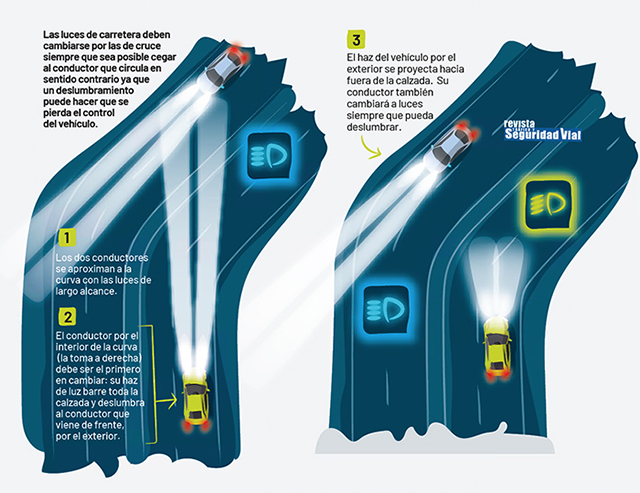
Special Case on Curves: When approaching a curve on a two-way road, the driver traveling on the inside of the curve (to their right) is the first who may dazzle oncoming traffic. Therefore, this driver must be the first to switch from high-beam to low-beam light.
Lights for Adverse Conditions
Front Fog Light: This is an optional lighting system. Its function is to reinforce lighting in conditions of fog, heavy rain, snowfall or dust clouds. It can be used alone or together with low-beam or high-beam lights.
Rear Fog Light: This is a very powerful red light, designed to be seen from behind in extreme conditions. Its use is mandatory only in especially unfavorable weather conditions (thick fog, very heavy rain, heavy snowfall). It is prohibited to use it in light rain or mild fog, as its intensity can dazzle and be very bothersome to drivers behind.
Other Important Lights
Hazard Lights (Warning): Used to signal a danger, such as a breakdown, a stop on the road, or to warn of a traffic jam. If you stop on a motorway or in a tunnel, you must activate them together with the position lights.
Clearance Lights: Mandatory for vehicles exceeding 2.10 meters in width, to indicate their total size.
Reflectors: These are reflective, non-luminous devices that return light from an external source. They are a crucial passive safety element for being seen when the vehicle is parked.
Lighting Technologies
Headlight technology has evolved to offer better visibility and efficiency.
Halogen: The most common and economical. They have a limited lifespan (about 500 hours).
Xenon (HID): They offer a whiter and more powerful light than halogen and consume less energy, lasting up to 4 times longer. They require time to reach maximum intensity.
LED: They turn on instantly, have very low consumption and a very long lifespan (about 10,000 hours). They allow more complex headlight designs.
Laser: The most advanced technology. It offers a range of up to 600 meters, four times more than LED, with lower energy consumption. Its cost is high.
Daytime Running Lights (DRL) and Visibility
To improve visibility during the day, many modern vehicles are equipped with Daytime Running Lights (DRL). These lights turn on automatically when the engine is started and make the vehicle much more visible to other drivers and pedestrians.
According to European studies, the widespread use of lights during the day could reduce road deaths by 10%.
A vehicle with daytime or low-beam lights on is visible from about 240 meters, more than double the distance of a vehicle without lights.
If your vehicle does not have DRL, the Directorate General of Traffic (DGT) strongly recommends driving with low-beam (dipped) lights on during the day, especially on interurban roads.
Transport of Cargo and People
Inadequate transport of people or goods directly affects the stability, braking and general safety of the vehicle.
Transport of People
The fundamental rule is to never exceed the number of seats for which the vehicle is authorized, as stated in its technical inspection record. The safety of minors is an absolute priority.
Child Restraint Systems (CRS): Minors with a height equal to or less than 135 cm must travel in the rear seats using an approved restraint system adapted to their size and weight.
Exceptions for traveling in front: A minor with their CRS may occupy the front seat only if the vehicle has no rear seats, if all the rear seats are already occupied by other minors with CRS, or if it is not possible to install all the CRS in those seats.
Transport of Cargo
The cargo must be well distributed and secured so that it cannot fall, drag or compromise the stability of the vehicle. A high or displaced center of gravity due to poorly placed cargo increases the risk of rollover and braking distance.
Dimensions and Signaling of Protruding Cargo
Regulations on protruding cargo are strict and vary according to the type of vehicle.
In passenger cars: The cargo can never protrude from the front or sides. From the rear, it may protrude 10% of the length of the vehicle if the cargo is divisible, or 15% if it is indivisible (for example, a kayak or a surfboard).
Signaling (V-20 Panel): All cargo protruding from the rear must be signaled with a square panel (50x50 cm) with diagonal red and white stripes, known as the V-20 panel. If the cargo occupies the entire width of the vehicle, two panels must be placed at the ends, forming an inverted 'V'.
Nighttime lighting: If driving at night or in low visibility with cargo protruding from the rear, in addition to the V-20 panel, a red light must be added. If the cargo protrudes from the front (only allowed in certain goods vehicles), a white light must be added.