Traffic Flow, Speed and Right of Way (Includes Driving Techniques)
General Traffic Rules
The correct flow of traffic and road safety depend on compliance with a set of rules that dictate how drivers must behave on the road. The fundamental principle is anticipation and mutual respect among all users.
Position on the Road
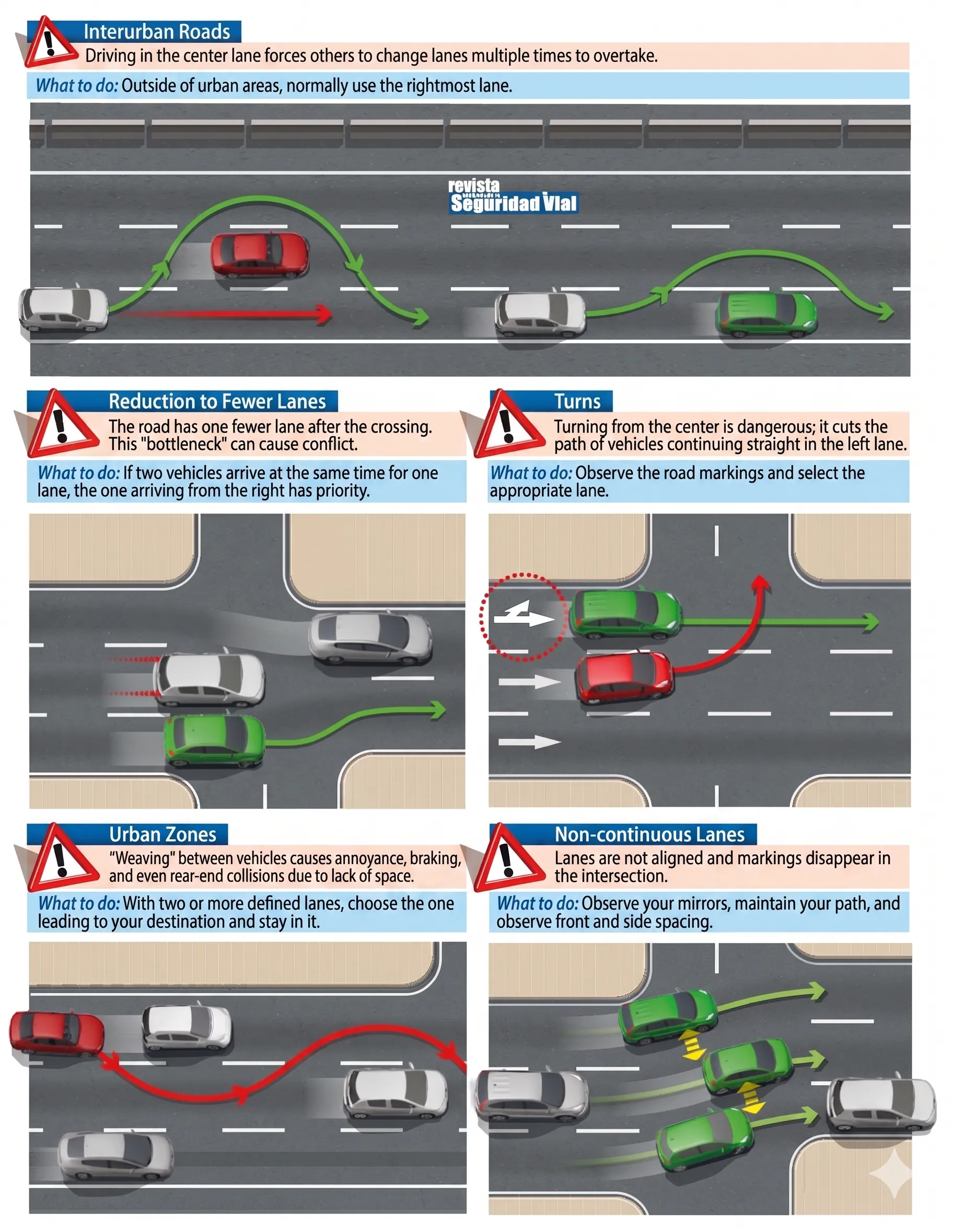
As a general rule, every vehicle must travel in the rightmost lane, reserving the left lanes for overtaking. Once the manoeuvre is completed, it is mandatory to return to the right lane as soon as it is safe. On roads without lanes marked by road markings, the same logic must be followed, driving as close as possible to the right edge of the road.
Use of Special Lanes
To manage traffic flow, there are lanes whose use is specifically regulated:
Reversible Lane: Its direction of travel can change according to traffic needs, indicated by lane traffic lights. It is mandatory to drive with the dipped headlights on at all times.
Lane in the Opposite Direction to Normal: Temporarily enabled on two-way roads. If it is for traffic flow purposes, only cars and motorcycles can use it at a speed between 60 and 80 km/h and with dipped headlights. If it is due to roadworks, all vehicles permitted on the road can use it, under the same speed and lighting conditions.
Circumstantial Additional Lane: Created by using the hard shoulders on conventional roads. The speed is limited between 60 and 80 km/h and also requires the use of dipped headlights.
HOV Lane (High Occupancy Vehicles): Reserved for vehicles with a minimum number of occupants, motorcycles, buses and vehicles with the ZERO emissions label.
Use of the Hard Shoulder and Central Reservation
The hard shoulder is a part of the road excluded from general traffic. Its use is strictly reserved for stopping due to emergencies, breakdowns or physical discomfort. It must never be used to drive, stop for a rest or as a shortcut in a traffic jam. The central reservation, which separates the directions of traffic, can only be used for an emergency stop if it is impossible to do so on the right-hand hard shoulder.
Speed
Speed must always be adapted to the circumstances of the road, traffic, weather conditions and the vehicle itself. Respecting the limits is a legal obligation and a necessity for safety.
Generic Speed Limits
The maximum limits vary according to the type of road and vehicle:
Motorways and dual carriageways: 120 km/h for cars and motorcycles; 100 km/h for buses; 90 km/h for trucks and vans.
Conventional roads: 90 km/h for cars and motorcycles; 90 km/h for buses; 80 km/h for trucks and vans.
Attention: The rule that allowed exceeding the maximum speed by 20 km/h to overtake on conventional roads has been eliminated. The limit is strict at all times.
Vehicle Type | Motorways and Dual Carriageways | Conventional Roads |
|---|---|---|
Cars, motorcycles and pick-ups | 120 km/h | 90 km/h |
Buses and vehicles derived from cars | 100 km/h | 90 km/h |
Trucks, vans and cars with trailer | 90 km/h | 80 km/h |
Limits in Urban Roads and Built-up Areas
In built-up areas, the protection of vulnerable users is a priority:
20 km/h: On single-platform roads (road and pavement at the same level).
30 km/h: On roads with a single lane per direction of travel.
50 km/h: On roads with two or more lanes per direction of travel.
80 km/h: Generic limit for motorways and dual carriageways that run within built-up areas.
Minimum and Abnormally Low Speed
Driving at an excessively slow speed without justification can be as dangerous as speeding. It is forbidden to drive at a speed below the minimum permitted. This is 60 km/h on motorways and dual carriageways, and half of the generic limit on other roads (for example, 45 km/h on a conventional road with a 90 km/h limit).
Manoeuvres and Driving Techniques
Any alteration of the position or movement of the vehicle is considered a manoeuvre and must be executed following the safety rule MSM: Mirror, Signal and Manoeuvre. First the surroundings are observed, then the intention is warned with the indicators or arm and, finally, the action is performed safely.
Joining and Exiting Fast Roads
To join a motorway or dual carriageway, the acceleration lane is used. In it, an appropriate speed must be reached to merge into the flow of traffic without obstructing it, always giving way to vehicles already travelling on the main road. To exit, you must enter the deceleration lane as soon as possible and reduce speed within it, not on the main road. On the other hand, if this is not possible, you will have to give way and even stop, if necessary, at the beginning of the lane, with metres ahead to acquire an appropriate speed and not be an obstacle. And if you cannot see the 'gap', it is better to wait: launching 'blindly' would be getting into a real 'dead end'.
Overtaking
It is one of the most risky manoeuvres. The general rule is to always overtake on the left.
Overtaking on the Right
Exceptionally, overtaking on the right is permitted, if there is sufficient space, in three specific situations:
When the vehicle in front of us clearly indicates its intention to turn left or stop on that side.
On urban roads with at least two delimited lanes for the same direction.
To trams that travel in a central area on two-way roads.
Prohibitions and Exceptions when Overtaking
As a general rule, overtaking is prohibited in places that compromise safety: curves and changes of gradient with reduced visibility, signposted pedestrian crossings, intersections, level crossings and tunnels.
However, there are important exceptions where overtaking is permitted, even in sections with a prohibition, provided it is done safely:
At intersections: Only if right of way is expressly signposted. Roundabouts are a type of intersection where overtaking is permitted if dimensions allow.
At level crossings: Only to two-wheeled vehicles (bicycles, motorcycles) that do not impede lateral visibility.
In tunnels: If there are two or more lanes for the same direction, since it is not necessary to invade the opposite direction.
To cyclists: They can be overtaken on a continuous line, occupying part or all of the opposite lane, provided a minimum lateral separation of 1.5 metres is maintained and the manoeuvre is safe.
To other slow users: The previous rule extends to pedestrians, animals, mopeds and animal-drawn vehicles.
To stationary vehicles: A stationary vehicle (for example, double-parked) can be overtaken by invading the opposite direction, provided it is not stopped due to traffic requirements (a traffic light) and the manoeuvre does not entail danger.
Stopping and Parking
It is essential to distinguish these concepts:
Stopping: Voluntary immobilisation of the vehicle for a period of less than 2 minutes, without the driver leaving it.
Parking: Immobilisation that is neither a stop nor a detention forced by traffic.
Double parking is prohibited. On two-way urban roads, you must park on the right side; on one-way roads, you can park on both sides if permitted.
Reversing
It is only permitted as a complementary manoeuvre (e.g. to park) and with the minimum essential distance. It is prohibited to travel more than 15 metres and to invade a road junction.
Right of Way
Right of way organises traffic at junctions and prevents conflicts.
General Rule of Priority
At an unsigned intersection, the rule is to always give way to vehicles approaching from the right.
Signs and Hierarchy
Signs prevail over the general rule. The order of priority is: 1st Traffic officers, 2nd Circumstantial signs (roadworks), 3rd Traffic lights, 4th Vertical signs (STOP, Give Way), 5th Road markings. A STOP sign requires a complete stop, while a Give Way only requires stopping if other vehicles are coming.
Specific Cases of Priority
Roundabouts: Vehicles already travelling on the rotating ring have priority. To exit, it is mandatory to do so from the outer lane.
Narrow passages: Without signage, the vehicle that entered first has priority. On sections with a steep gradient, the vehicle going up has priority.
Priority vehicles: Ambulances, police or firefighters on emergency duty (with light and/or sound signals) have absolute priority over all other users.
Pedestrians and cyclists: They have priority at their duly signposted crossings.