Chapter Preview
1. At intersections:
In the following table you can see the right of way priorities between cars at intersections.
Signposted Intersections | Intersections without signposts |
|---|---|
Signals which regulate right of way should be obeyed | Right of way rules apply |
1 Officers Trick: Only Tigers Like Very Small Lemon Machines (bolded letters) | Exceptions:
|
2. Narrow sections:
In narrow sections, to find out which vehicle goes first:
1- Signals for the narrow section
My direction has priority
The other direction has priority
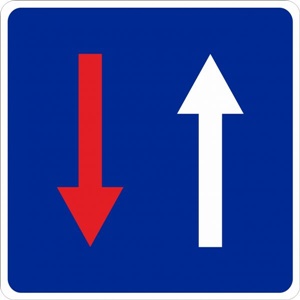
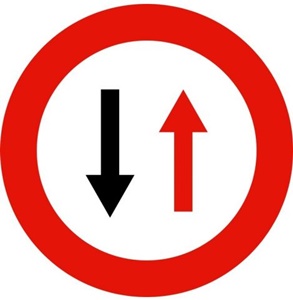
2- If there are no signals, whoever enters first
3- If it is not clear who entered first, whoever will have more difficulty manoeuvring should enter first. Look at the table:
Order of preference
1 Special vehicles providing special transport
2 Articulated vehicles and tractive units
3 Vehicles pulled by animals
4 Passenger Car with trailer up to 750kg and motorhomes/RVs
5 Collective passenger transport vehicles
6 Lorries/trucks, tractor-trailers and vans
7 Passenger cars and derivative of cars
8 Special vehicles that do not exceed the established mass, quadricycles and light quadricycles
9 Tricycles, motorcycles with sidecar and 3-wheel mopeds
10 Motorcycles, 2-wheel mopeds and bicycles
4- If vehicles are of the same type, whoever would have to reverse a greater distance
5- If both have to reverse the same distance, whoever has the greater width, weight or length
3. On gradients:
The vehicle ascending (going uphill) has right of way as a general rule, unless there is a lay-by.
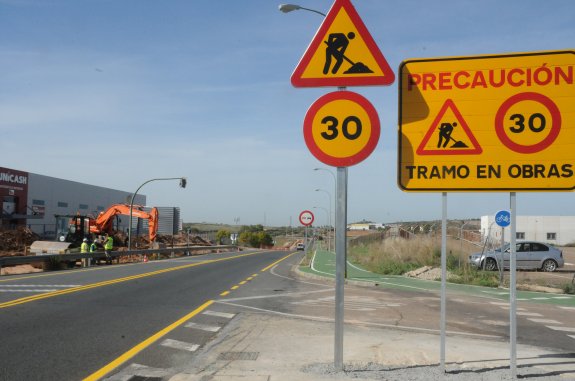
4. Construction:
We should pay attention to the construction signals and signs given by workers on roadways under construction. Road markings that indicate road construction are yellow.
5. Other rights of way
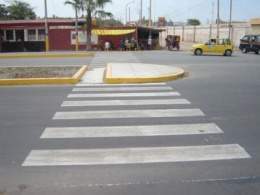 | Pedestrians:
|
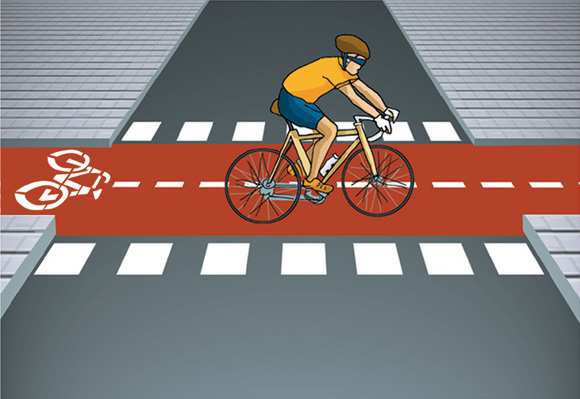 | Cyclists:
|
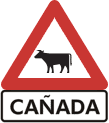 | Animals:
|
5.1 Vehicles in response to emergency situations
High-priority vehicles: police, fire service, ambulance and civil defence
Will travel with both light and auditory signals or only light
They are NOT required to follow traffic regulations (under their own responsibility) and they must always respect the orders of the agents
You must facilitate their passing, moving away and even stopping
NON high-priority vehicles: private vehicles performing some urgent service
Must comply with all traffic regulations. May signal using a handkerchief or short beeps with the horn.
5.2 Emergency situations:
1. If you break down at a level crossing or drawbridge you should:
Evacuate the occupants
Signal the engineer and drivers about your situation
Attempt to remove the vehicle quickly
2. In tunnels and underpasses:
a) In an emergency:
Stop the engine, turn on emergency and position lights, activate the connected V-16 emergency beacon when required
Leave the vehicle and seek shelter or leave the tunnel
b) For traffic requirements (traffic jam):
Stop the engine, turn on emergency and position lights
DO NOT leave the vehicle
c) In a fire:
Park vehicle on the right and turn off the engine
Leave the keys in the ignition and doors open
Leave the vehicle and seek shelter or leave the tunnel in the opposite direction to fire
Create a free account to read the full chapter
Track your progress, use AI tools, and prepare for your driving exam — all for free.