When driving in fog, the driver must...
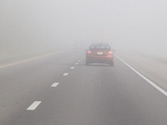
A)get as close as possible to the vehicle ahead in order to see it better.
B)stop on the carriageway until the fog clears.
C)adapt speed to the atmospheric visibility conditions.Correct
The main drawback of driving in fog is that visibility is reduced and the road surface may be slippery. Since our visibility will be reduced, we must adapt our speed to our field of vision and also drive with the appropriate lighting.
FRONT FOG LIGHTS:
- Their installation and use is NOT mandatory.
- They shall be white or selective yellow in colour.
- They shall be used, voluntarily, in the event of fog, heavy rain, snowfall, clouds of smoke or dust, or in circumstances similar to the above.
- They may also be used on narrow roads with many bends — that is, those with a carriageway width of 6.5 m or less, signposted with 'dangerous bends' signs.
REAR FOG LIGHTS:
- Their installation and use is mandatory.
- They shall be red in colour.
- They shall be used, mandatorily, in the event of THICK fog, VERY heavy rain, HEAVY snowfall, or DENSE clouds of smoke or dust.
The front fog lights, during the day, may be switched on with only the sidelights, but may also be used together with the dipped or full-beam headlights. At night, they shall be used at minimum with the dipped headlights.
The rear fog lights, during the day, shall be used at minimum together with the front fog lights or the dipped headlights. At night, at minimum with the dipped headlights.