When overtaking the cyclist, you must...
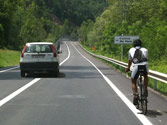
A)Leave a lateral separation of at least 1.50 metres and not cross the solid line.
B)Leave a lateral separation of at least 1.50 metres and cross the solid line to move into the lane partially or completely.Correct
C)At this moment I cannot overtake the cyclist because the solid line prohibits it.
Even if overtaking is prohibited, you may invade the part reserved for the opposite direction in order to:
- Overtake slow and vulnerable users (cycles, mopeds, pedestrians, animals and animal-drawn vehicles), when their speed allows the manoeuvre to be performed without risk.
- Pass obstacles or immobilised vehicles (broken down, involved in an accident, etc.), after making sure there is no danger (if the reason for the immobilisation is imposed by traffic needs, you may not pass, and must remain behind it).
When overtaking outside built-up areas pedestrians, animals, two-wheeled or animal-drawn vehicles, vehicles immobilised on the road, or assistance vehicles when they are carrying out aid and rescue operations, the manoeuvre must be carried out by occupying part or all of the adjacent lane of the carriageway.
If there is more than one lane in our direction, the adjacent lane must be invaded entirely, and a lane change is mandatory when overtaking cycles, mopeds or groups of them.
In any case, the lateral separation shall not be less than 1.50 metres.
When overtaking a vehicle other than the above, or when the overtaking takes place in a built-up area and is not directed at a cycle or moped, a lateral safety margin proportional to the speed and to the width and characteristics of the carriageway shall be maintained. When overtaking a cycle or moped in a built-up area, we must leave a lateral separation of not less than 1.50 metres, just as we do outside built-up areas. Therefore, in the case of the question, it is correct to cross the solid line in order to overtake the cyclist and thus be able to keep the 1.50 m.
- Overtake slow and vulnerable users (cycles, mopeds, pedestrians, animals and animal-drawn vehicles), when their speed allows the manoeuvre to be performed without risk.
- Pass obstacles or immobilised vehicles (broken down, involved in an accident, etc.), after making sure there is no danger (if the reason for the immobilisation is imposed by traffic needs, you may not pass, and must remain behind it).
When overtaking outside built-up areas pedestrians, animals, two-wheeled or animal-drawn vehicles, vehicles immobilised on the road, or assistance vehicles when they are carrying out aid and rescue operations, the manoeuvre must be carried out by occupying part or all of the adjacent lane of the carriageway.
If there is more than one lane in our direction, the adjacent lane must be invaded entirely, and a lane change is mandatory when overtaking cycles, mopeds or groups of them.
In any case, the lateral separation shall not be less than 1.50 metres.
When overtaking a vehicle other than the above, or when the overtaking takes place in a built-up area and is not directed at a cycle or moped, a lateral safety margin proportional to the speed and to the width and characteristics of the carriageway shall be maintained. When overtaking a cycle or moped in a built-up area, we must leave a lateral separation of not less than 1.50 metres, just as we do outside built-up areas. Therefore, in the case of the question, it is correct to cross the solid line in order to overtake the cyclist and thus be able to keep the 1.50 m.