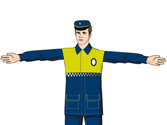
This officer with arms extended requires... to stop.
A)only drivers of vehicles approaching from behind.
B)only drivers approaching from the front.
C)all road users approaching the officer from any direction that crosses the one indicated by the arms.Correct
Officer signals:
- One or both arms extended horizontally: This signal requires all road users approaching the officer from directions that cross the one indicated by the extended arm or arms to stop, regardless of their direction of travel.
This signal remains in force even if the officer lowers their arm or arms, as long as they do not change position or make another signal.
- Arm raised vertically: Requires all road users approaching the officer to stop, except drivers who cannot do so safely.
The stop must be made at the nearest stop line or, failing that, immediately before the officer. At an intersection, the stop must be made before entering it.
After this signal, the officer may indicate, where appropriate, the place where the stop must be made.
- Swinging of a red or amber light: Requires road users towards whom the officer directs the light to stop.
- Arm extended moving alternately up and down: Requires drivers approaching the officer on the side corresponding to the arm making the signal, and perpendicular to that arm, to reduce their vehicle's speed.
- One or both arms extended horizontally: This signal requires all road users approaching the officer from directions that cross the one indicated by the extended arm or arms to stop, regardless of their direction of travel.
This signal remains in force even if the officer lowers their arm or arms, as long as they do not change position or make another signal.
- Arm raised vertically: Requires all road users approaching the officer to stop, except drivers who cannot do so safely.
The stop must be made at the nearest stop line or, failing that, immediately before the officer. At an intersection, the stop must be made before entering it.
After this signal, the officer may indicate, where appropriate, the place where the stop must be made.
- Swinging of a red or amber light: Requires road users towards whom the officer directs the light to stop.
- Arm extended moving alternately up and down: Requires drivers approaching the officer on the side corresponding to the arm making the signal, and perpendicular to that arm, to reduce their vehicle's speed.